• Trade
  • Markets
  • Copy
  • Contests
  • News
  • 24/7
  • Calendar
  • Q&A
  • Chats
Trending
Screeners
SYMBOL
LAST
BID
ASK
HIGH
LOW
NET CHG.
%CHG.
SPREAD
SPX
S&P 500 Index
6870.39
6870.39
6870.39
6895.79
6858.28
+13.27
+ 0.19%
--
DJI
Dow Jones Industrial Average
47954.98
47954.98
47954.98
48133.54
47871.51
+104.05
+ 0.22%
--
IXIC
NASDAQ Composite Index
23578.12
23578.12
23578.12
23680.03
23506.00
+72.99
+ 0.31%
--
USDX
US Dollar Index
98.930
99.010
98.930
98.960
98.730
-0.020
-0.02%
--
EURUSD
Euro / US Dollar
1.16496
1.16504
1.16496
1.16717
1.16341
+0.00070
+ 0.06%
--
GBPUSD
Pound Sterling / US Dollar
1.33154
1.33163
1.33154
1.33462
1.33136
-0.00158
-0.12%
--
XAUUSD
Gold / US Dollar
4211.84
4212.25
4211.84
4218.85
4190.61
+13.93
+ 0.33%
--
WTI
Light Sweet Crude Oil
59.221
59.251
59.221
60.084
59.160
-0.588
-0.98%
--

Community Accounts

Signal Accounts
--
Profit Accounts
--
Loss Accounts
--
View More

Become a signal provider

Sell trading signals to earn additional income

View More

Guide to Copy Trading

Get started with ease and confidence

View More

Signal Accounts for Members

All Signal Accounts

Best Return
  • Best Return
  • Best P/L
  • Best MDD
Past 1W
  • Past 1W
  • Past 1M
  • Past 1Y

All Contests

  • All
  • Trump Updates
  • Recommend
  • Stocks
  • Cryptocurrencies
  • Central Banks
  • Featured News
Top News Only
Share

India Foreign Ministry: Advise Indian Nationals To Exercise Caution While Travelling To Or Transiting Through China

Share

Christian Association Of Nigeria: Nigerian Government Rescues 100 Schoolchildren Kidnapped From Catholic School Last Month

Share

Mother Of Last Gaza Hostage Says Israel Won't Heal Until He's Back

Share

Agrural - Brazil's 2025/26 Total Corn Output Seen At 135.3 Million Tonnes Versus 141.1 Million Tonnes In Previous Season

Share

Agrural - Brazil's 2025/26 Soybean Planting Hits 94% Of Expected Area As Of Last Thursday

Share

S.Africa's Eskom Says Regulator Nersa Is Processing An Application For An Interim Tariff Adjustment For The Smelters, While Government Is Working On A Complementary Mechanism To Support A More Competitive Pricing Path For The Sector

Share

SEBI: Modalities For Migration To Ai Only Schemes And Relaxations To Large Value Funds For Accredited Investors

Share

All 6 Bank Of Israel Monetary Policy Committee Members Voted To Lower Benchmark Interest Rate 25 Bps To 4.25% On Nov 24

Share

India Government: Cancellations Are On Account Of Developer Delays And Not Due To Transmission Side Delays

Share

Fitch: We See Moderation Of Export Performance In China In 2026

Share

India Government: Revokes Grid Access Permissions For Renewable Energy Projects

Share

Stats Office - Tanzania Inflation At 3.4% Year-On-Year In November

Share

Temasek CEO Dilhan Pillay: We Are Taking A Conservative Stance On Allocating Capital

Share

Brazil Economists See Brazilian Real At 5.40 Per Dollar By Year-End 2025 Versus 5.40 In Previous Estimate - Central Bank Poll

Share

Brazil Economists See Year-End 2026 Interest Rate Selic At 12.25% Versus 12.00% In Previous Estimate - Central Bank Poll

Share

Brazil Economists See Year-End 2025 Interest Rate Selic At 15.00% Versus 15.00% In Previous Estimate - Central Bank Poll

Share

EU Commission Says Meta Has Committed To Give EU Users Choice On Personalised Ads

Share

Sources Revealed That The Bank Of England Has Invited Employees To Voluntarily Apply For Layoffs

Share

The Bank Of England Plans To Cut Staff Due To Budget Pressures

Share

Traders Believe There Is Less Than A 10% Chance That The European Central Bank Will Cut Interest Rates By 25 Basis Points In 2026

TIME
ACT
FCST
PREV
France Industrial Output MoM (SA) (Oct)

A:--

F: --

P: --
France Trade Balance (SA) (Oct)

A:--

F: --

P: --
Euro Zone Employment YoY (SA) (Q3)

A:--

F: --

P: --
Canada Part-Time Employment (SA) (Nov)

A:--

F: --

P: --

Canada Unemployment Rate (SA) (Nov)

A:--

F: --

P: --

Canada Full-time Employment (SA) (Nov)

A:--

F: --

P: --

Canada Labor Force Participation Rate (SA) (Nov)

A:--

F: --

P: --

Canada Employment (SA) (Nov)

A:--

F: --

P: --

U.S. PCE Price Index MoM (Sept)

A:--

F: --

P: --

U.S. Personal Income MoM (Sept)

A:--

F: --

P: --

U.S. Core PCE Price Index MoM (Sept)

A:--

F: --

P: --

U.S. PCE Price Index YoY (SA) (Sept)

A:--

F: --

P: --

U.S. Core PCE Price Index YoY (Sept)

A:--

F: --

P: --

U.S. Personal Outlays MoM (SA) (Sept)

A:--

F: --

P: --
U.S. 5-10 Year-Ahead Inflation Expectations (Dec)

A:--

F: --

P: --

U.S. Real Personal Consumption Expenditures MoM (Sept)

A:--

F: --

P: --
U.S. Weekly Total Rig Count

A:--

F: --

P: --

U.S. Weekly Total Oil Rig Count

A:--

F: --

P: --

U.S. Consumer Credit (SA) (Oct)

A:--

F: --

P: --
China, Mainland Foreign Exchange Reserves (Nov)

A:--

F: --

P: --

Japan Trade Balance (Oct)

A:--

F: --

P: --

Japan Nominal GDP Revised QoQ (Q3)

A:--

F: --

P: --

China, Mainland Imports YoY (CNH) (Nov)

A:--

F: --

P: --

China, Mainland Exports (Nov)

A:--

F: --

P: --

China, Mainland Imports (CNH) (Nov)

A:--

F: --

P: --

China, Mainland Trade Balance (CNH) (Nov)

A:--

F: --

P: --

China, Mainland Exports YoY (USD) (Nov)

A:--

F: --

P: --

China, Mainland Imports YoY (USD) (Nov)

A:--

F: --

P: --

Germany Industrial Output MoM (SA) (Oct)

A:--

F: --

P: --
Euro Zone Sentix Investor Confidence Index (Dec)

A:--

F: --

P: --

Canada National Economic Confidence Index

--

F: --

P: --

U.K. BRC Like-For-Like Retail Sales YoY (Nov)

--

F: --

P: --

U.K. BRC Overall Retail Sales YoY (Nov)

--

F: --

P: --

Australia Overnight (Borrowing) Key Rate

--

F: --

P: --

RBA Rate Statement
RBA Press Conference
Germany Exports MoM (SA) (Oct)

--

F: --

P: --

U.S. NFIB Small Business Optimism Index (SA) (Nov)

--

F: --

P: --

Mexico 12-Month Inflation (CPI) (Nov)

--

F: --

P: --

Mexico Core CPI YoY (Nov)

--

F: --

P: --

Mexico PPI YoY (Nov)

--

F: --

P: --

U.S. Weekly Redbook Index YoY

--

F: --

P: --

U.S. JOLTS Job Openings (SA) (Oct)

--

F: --

P: --

China, Mainland M1 Money Supply YoY (Nov)

--

F: --

P: --

China, Mainland M0 Money Supply YoY (Nov)

--

F: --

P: --

China, Mainland M2 Money Supply YoY (Nov)

--

F: --

P: --

U.S. EIA Short-Term Crude Production Forecast For The Year (Dec)

--

F: --

P: --

U.S. EIA Natural Gas Production Forecast For The Next Year (Dec)

--

F: --

P: --

U.S. EIA Short-Term Crude Production Forecast For The Next Year (Dec)

--

F: --

P: --

EIA Monthly Short-Term Energy Outlook
U.S. API Weekly Gasoline Stocks

--

F: --

P: --

U.S. API Weekly Cushing Crude Oil Stocks

--

F: --

P: --

U.S. API Weekly Crude Oil Stocks

--

F: --

P: --

U.S. API Weekly Refined Oil Stocks

--

F: --

P: --

South Korea Unemployment Rate (SA) (Nov)

--

F: --

P: --

Japan Reuters Tankan Non-Manufacturers Index (Dec)

--

F: --

P: --

Japan Reuters Tankan Manufacturers Index (Dec)

--

F: --

P: --

Japan Domestic Enterprise Commodity Price Index MoM (Nov)

--

F: --

P: --

Japan Domestic Enterprise Commodity Price Index YoY (Nov)

--

F: --

P: --

China, Mainland PPI YoY (Nov)

--

F: --

P: --

China, Mainland CPI MoM (Nov)

--

F: --

P: --

Q&A with Experts
    • All
    • Chatrooms
    • Groups
    • Friends
    Connecting
    .
    .
    .
    Type here...
    Add Symbol or Code

      No matching data

      All
      Trump Updates
      Recommend
      Stocks
      Cryptocurrencies
      Central Banks
      Featured News
      • All
      • Russia-Ukraine Conflict
      • Middle East Flashpoint
      • All
      • Russia-Ukraine Conflict
      • Middle East Flashpoint
      Search
      Products

      Charts Free Forever

      Chats Q&A with Experts
      Screeners Economic Calendar Data Tools
      Membership Features
      Data Warehouse Market Trends Institutional Data Policy Rates Macro

      Market Trends

      Market Sentiment Order Book Forex Correlations

      Top Indicators

      Charts Free Forever
      Markets

      News

      News Analysis 24/7 Columns Education
      From Institutions From Analysts
      Topics Columnists

      Latest Views

      Latest Views

      Trending Topics

      Top Columnists

      Latest Update

      Signals

      Copy Rankings Latest Signals Become a signal provider AI Rating
      Contests
      Brokers

      Overview Brokers Assessment Rankings Regulators News Claims
      Broker listing Forex Brokers Comparison Tool Live Spread Comparison Scam
      Q&A Complaint Scam Alert Videos Tips to Detect Scam
      More

      Business
      Events
      Careers About Us Advertising Help Center

      White Label

      Data API

      Web Plug-ins

      Affiliate Program

      Awards Institution Evaluation IB Seminar Salon Event Exhibition
      Vietnam Thailand Singapore Dubai
      Fans Party Investment Sharing Session
      FastBull Summit BrokersView Expo
      Recent Searches
        Top Searches
          Markets
          News
          Analysis
          User
          24/7
          Economic Calendar
          Education
          Data
          • Names
          • Latest
          • Prev

          View All

          No data

          Scan to Download

          Faster Charts, Chat Faster!

          Download App
          English
          • English
          • Español
          • العربية
          • Bahasa Indonesia
          • Bahasa Melayu
          • Tiếng Việt
          • ภาษาไทย
          • Français
          • Italiano
          • Türkçe
          • Русский язык
          • 简中
          • 繁中
          Open Account
          Search
          Products
          Charts Free Forever
          Markets
          News
          Signals

          Copy Rankings Latest Signals Become a signal provider AI Rating
          Contests
          Brokers

          Overview Brokers Assessment Rankings Regulators News Claims
          Broker listing Forex Brokers Comparison Tool Live Spread Comparison Scam
          Q&A Complaint Scam Alert Videos Tips to Detect Scam
          More

          Business
          Events
          Careers About Us Advertising Help Center

          White Label

          Data API

          Web Plug-ins

          Affiliate Program

          Awards Institution Evaluation IB Seminar Salon Event Exhibition
          Vietnam Thailand Singapore Dubai
          Fans Party Investment Sharing Session
          FastBull Summit BrokersView Expo

          Why China Concepts Stocks Post Their Strongest One-month Gains Ever in November? 

          King Ten
          Summary:

          On the last closing day of November, the Nasdaq Golden Dragon China Index (HXC) intra-day gains continued to expand after Powell's speech, eventually closing with 9.62% higher, a cumulative gain of 42.13% in November, and the largest single-month gain in history. Comparatively, in entire November, the S&P 500 rose 5.38%, the Dow rose 5.67%, and the Nasdaq also rose only 4.48%. China Concepts Stocks that have fallen for more than a year and a half and hit their lowest levels since 2013 made the strongest rebound. Is Wall Street beginning to change its previous position?
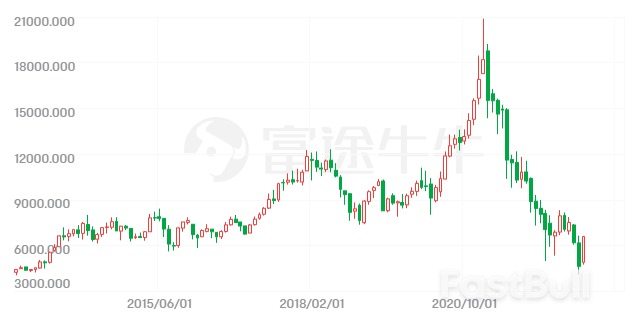
          The November with Significant Rebounds

          In November, the U.S. stock market was up and down under the influence of factors such as the midterm elections and the Fed's interest rate hike expectations. However, China Concepts Stocks have maintained the momentum of rising against the market, which was surprising because they had fallen for 20 months before, and now the trend is reversed to rise more than 42% and set the largest single-month maximum gain in history, as shown in the chart below (NASDAQ Golden Dragon China Index (HXC)).
          Only on the closing day of November, the HXC's components were led by gains with 47% in Xiaopeng 12% in Bilibili, nearly 10% in Alibaba, more than 9% in Ctrip, and about 9% in Baidu. In addition, other electric car stocks also rose sharply, with NIO rising by nearly 22% and Li Auto Inc. surging by nearly 19%.
          Why China Concepts Stocks Post Their Strongest One-month Gains Ever in November? _1

          Why Can China Concepts Stocks Soar Against the Market?

          The strong rally in China Concepts Stocks is not occasional, as Wall Street is changing its previous negative attitude to some extent, with institutions such as Morgan Stanley, Bank of America, and Goldman Sachs recently expressing bullishness about the future performance of China Concepts Stocks. Furthermore, other economists including Robin Brooks, chief economist at the Institute of International Finance (IIF), and Stephen Roach, former chief economist at Morgan Stanley and a senior fellow at Yale University, have also recently declared that the most important driver of the global economy next year will be China and that the attractiveness of Chinese assets is accelerating.
          The data also indicates that after the USDCNH hit a high of 7.37 at the end of October, the whole month of November was in a shockingly low trend and touched a low near 7.01 twice. It means that foreign capital is accelerating to flow into the Chinese market. Additionally, the latest data from EPFR Global, the capital flow monitoring and research institution, exhibits that there were net inflows into China's equity funds in 13 of the last 15 weeks (ended Nov. 26th), with net inflows expanding in November.
          Why have Chinese assets suddenly become more attractive? In addition to the strong quarterly results of these institutions repairing the market's pessimistic expectations, perhaps more pragmatic measures such as China's optimization and adjustment of the 20 measures to further optimize 'pandemic prevention and control work', and 'China's 16-point plan to rescue its ailing property sector', while more economic stimulus measures will continue to be launched. Step by step, the Chinese economy, and consumer spending will gradually recover and come out of the bottom, bringing a great improvement to market sentiment. Finally, political factors are also favorable. Vietnam's Prime Minister and German Chancellor visited China in early November, and the heads of China and the US also met in mid-November, greatly easing the long-term cold relationship between China and US. Meanwhile, it created the path for future friendly consultations. Perhaps this is also the main reason for Wall Street to change its negative attitude.
          Will the rebound be short-lived? Probably, many investors are still hesitating about whether this is a rebound or a reversal. I prefer that it is now the beginning of the inflection point.
          Firstly, external voices are already turning, including Goldman Sachs, which expects that China may be the only major economy to achieve positive growth in 2023, while Morgan Stanley and World Bank economists expect China's real GDP growth to rise from 3% this year to 4.5%-5% in 2023. Moreover, even Bank of America, which has been bearish on China for the past two years, has recently turned bullish on the Chinese market.
          Secondly, China should have passed the most difficult period, with a series of pragmatic policies being released for bailing out real estate, the mother of the economic cycle, is also showing signs of standing still. Besides, China's credit cycle is seeing accelerating improvement, and the continued optimization of the pandemic prevention and control policy is also recovering the private economy's vitality and confidence, which is significant.
          Finally, China's inflation is currently at a very comfortable level, and the exchange rate of the CNY is stable. China's loose monetary policy offers time and space to promote economic growth, which is the most fundamental for the reversal. Remember that the deposits of Chinese residents are growing, which will be the biggest hidden push.
          Risk Warnings and Disclaimers
          You understand and acknowledge that there is a high degree of risk involved in trading. Following any strategies or investment methods may lead to potential losses. The content on the site is provided by our contributors and analysts for information purposes only. You are solely responsible for determining whether any trading assets, securities, strategy, or any other product is suitable for investing based on your own investment objectives and financial situation.
          Comments
          Add to Favorites
          Share

          Climate Barriers to Global Trade

          Ukadike Micheal

          Energy

          At this year's United Nations Climate Change Conference, some 10,000 policymakers met to continue knitting the global web of climate regulation. An additional 20,000 people were attending as observers, mostly from nongovernmental organizations. More and more, global trade is becoming the focus of their regulatory hankering.
          The United Nations Framework Convention on Climate Change (UNFCCC) is a treaty with 198 signatory parties. Some of the UNFCCC's provisions have a clearly defined scope. One example is the Kyoto Protocol, which intends to curb the emission of greenhouse gasses in developed economies. Other clauses have a much broader range, for example, the Paris Agreement. The agreement is meant to coordinate global action to fight climate change. While primarily addressing national governments, the treaty also involves international and nongovernmental actors.
          There is no doubt that climate concerns will lead to restrictions on trade. The question is how and when.
          In principle, the Paris Agreement does not address the issue of trade specifically. But more and more, the worldwide exchange of goods and services is becoming an object of discussion under the agreement.
          For example, the UNFCCC has facilitated discussions about the environmental effects of global trade. Also, its secretariat regularly liaises about this topic with UN agencies, such as UNIDO (industrial development), UNCTAD (trade and development) or the UN Economics Commissions. The Intergovernmental Panel on Climate Change (IPCC) especially has put trade on its agenda. While its mission is to carry out research, its reports have political and regulatory consequences.

          Imported emissions

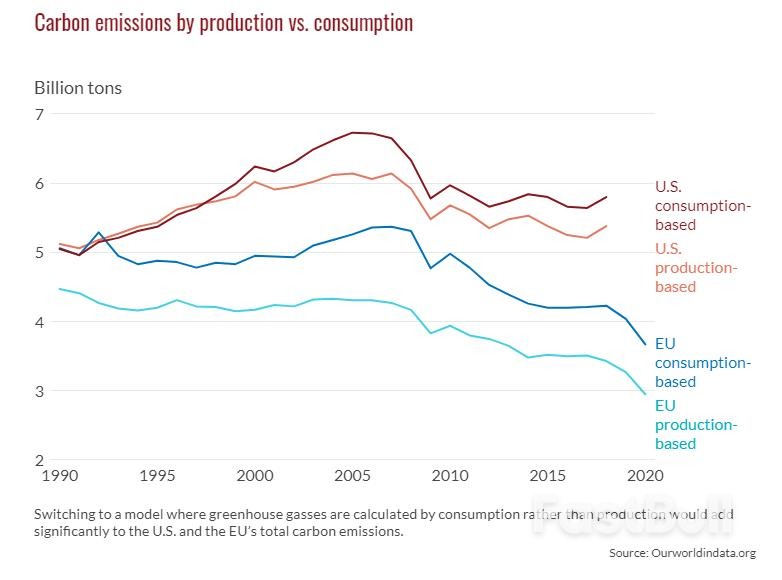
          So far, under the UNFCCC, greenhouse gas emissions are measured where they are produced. If a car manufacturer emits five tons of carbon dioxide in Brazil, this quantity is added to Brazil's inventory.
          Another way to measure greenhouse gasses is by consumption – tracking where goods and services reach their end user. According to this method, if a car producer in Brazil sells cars that emit three tons of CO2 in Brazil and two tons in Argentina, three tons should be added to Brazil's inventories and two to Argentina's. With this method, the netting of production and consumption leads to Brazil having 2 tons less and Argentina 2 tons more of “imported emissions.”
          This second method is not yet applied by the UNFCCC, but the IPCC is researching its implementation. Additionally, the Organisation for Economic Co-operation and Development (OECD) has included it in papers and databases.Climate Barriers to Global Trade_1
          The consequences of calculating emissions by consumption rather than production would be far-reaching. It would add significantly to the inventories of OECD countries, which could come under increased pressure to take drastic action to lower their emissions. This, in turn, is problematic.
          If emissions are calculated by consumption, net exporters of greenhouse gasses will be allowed to subtract emissions from their own inventories. With this method, exporting countries would be less incentivized to reduce their carbon footprint. Furthermore, mitigating emissions at the production level is generally much cheaper and improves existing infrastructure and economic processes.

          Restricting trade

          It can be argued that since the UNFCCC and the Paris Agreement are still sticking to the production method of calculating emissions, there is no need to worry. This is wrong on two accounts. First, some parties to the Paris Agreement are beginning to put barriers to trade based on the consumption principle. Second, even the World Trade Organization (WTO) is considering trade restrictions based on the consumption of greenhouse gasses.
          Carbon border adjustment mechanisms (CBAM) are an emerging set of trade policy tools that aim to prevent carbon-intensive economic activity from being imported from jurisdictions with less stringent regulations. Border adjustments would typically apply fees on imported goods based on the greenhouse gas emissions generated during their production abroad. This can also include deductions or exemptions from domestic policies for producers that export their goods.
          The European Union is currently considering implementing CBAM. Interest in border adjustments, including carbon tariffs, is also growing in the United States, with both Democrats and Republicans expressing support.
          Since CBAM are taxes that apply to imports, the measures would need to comply with WTO rules. A CBAM can be WTO-compatible if it avoids discriminating among foreign products with the same carbon footprint and treats all domestic production with the same tax. The wording, goals and application of border carbon adjustments should be entirely origin neutral.
          The WTO itself is seriously considering such steps. In its briefs on trade and climate change, the organization praises the growing number of climate-related national policies as well as the increase of climate provisions in free trade and regional trade agreements. While it notes how trade can mitigate greenhouse gas emissions, it also states that climate-related barriers to trade are compatible with WTO rules if a common standard for accounting emissions is established. The WTO effectively lays out the blueprint for restricting trade. Under the UNFCCC, the standardization of carbon accounting is well underway.

          Scenarios

          The most likely scenario is that global trade will be restricted based on climate change concerns. Regardless of whether this stems from legitimate reasons or serves to justify protectionism, the economic consequences will be dire. Less trade means more expensive goods in importing countries as well as fewer proceeds from trade in exporting ones, leading to a welfare loss. There will be less technology exchange, less competition, economic and social development, and potentially less climate action to mitigate emissions.
          Another possible scenario is a global divide. The EU, and potentially the U.S. and Canada, will adopt new trade restrictions while most other countries will not. This could propel the economic decline of the transatlantic protectionists while allowing for countries such as China, Brazil, Indonesia, Mexico, Nigeria, Russia and South Africa to integrate more into global trade networks. This would also boost their geopolitical influence.
          Yet another scenario is one in which trade fragments. In this scenario, international ties would fray, subsisting only among like-minded countries, resulting in isolationism and geopolitical frictions leading to global economic decline. Such an outcome would take a disproportionate toll on the poorest.
          These scenarios are all variations of a bad situation. There is little probability of a best-case scenario in which trade is seen as a tool to mitigate the effects of climate change. There is no political appetite for such an approach since even self-styled advocates of a liberal order, such as the OECD or the WTO, are considering barriers to trade. Even a neutral scenario, in which climate action does not infringe on trade, is highly unlikely if the EU adopts CBAM. There is, however, some optimism about the timeline, as restrictions may take a long while until implemented.
          There is no doubt that climate concerns will lead to restrictions on trade. The question is how and when. The EU's CBAM provide a blueprint for a regional set of barriers to foreign trade. The WTO's condition of a worldwide tariff system on standardized carbon accounting is another cornerstone in this development.
          Such restrictions will have a negative impact on the economy, social development, welfare and even geopolitics. They are also highly likely to interfere with efforts to combat climate change, especially the reduction of carbon emissions.

          Source: gisreportsonline

          Risk Warnings and Disclaimers
          You understand and acknowledge that there is a high degree of risk involved in trading. Following any strategies or investment methods may lead to potential losses. The content on the site is provided by our contributors and analysts for information purposes only. You are solely responsible for determining whether any trading assets, securities, strategy, or any other product is suitable for investing based on your own investment objectives and financial situation.
          Comments
          Add to Favorites
          Share

          China C.Bank to Offer Limited, Targeted Growth Support, No Bazooka

          Owen Li

          Central Bank

          China's $17 trillion economy is headed for one of its worst showings this year in almost half a century, but its central bank has limited options in its armoury for providing policy support as it would want to avoid stoking capital flight.
          The People's Bank of China (PBOC) is, therefore, poised to ramp up targeted support for troubled sectors, adding to the nearly $800 billion in loans it has already made through its structural tools, according to policy sources and analysts.
          The PBOC, while seeking to bolster an economy hobbled by COVID-19 curbs and a property malaise, is expected to avoid aggressive stimulus that could fuel inflationary pressures and risk outflows from China, weakening the yuan, they said.
          The PBOC's room to maneuver has been crimped by a global tightening spree led by the U.S. Federal Reserve's aggressive rate rises to tame inflation, although Fed Chair Jerome Powell has hinted its pace will be slowed.
          Since 2020, when the world's second-largest economy was first jolted by the coronavirus, the PBOC has expanded its arsenal of structural policy tools, including relending and rediscount facilities and other low-cost loans.
          It has offered cheap loans to support small firms, transport and logistics - sectors hardest hit by COVID - and sectors that fit within Beijing's long-term development goals such as tech innovation, elderly care, and carbon reduction.
          "The central bank is likely to expand the scope of structural policy tools and step up the use of such tools," said a person involved in policy discussions who spoke on condition of anonymity.
          "We will not resort to flood-like stimulus, but will make policy more targeted and more efficient to ensure reasonable and sufficient liquidity."
          The PBOC did not respond to Reuters' request for comment.
          Its outstanding loans made via structural tools amounted to nearly 5.6 trillion yuan ($781.64 billion) at the end of September, central bank data showed.
          The PBOC has pledged 200 billion yuan in special loans last month to rescue the property sector, and 154.3 billion yuan in loans in October to policy banks via its pledged supplementary Lending (PSL) facility to fund infrastructure projects.
          The central bank last week announced it would cut banks' reserve requirement ratio (RRR) for the second time this year, releasing about 500 billion yuan in long-term liquidity, reducing the room for using the traditional tool. The average reserve ratio has been slashed to 7.8% from 14.9% in 2018.
          "What I expect is that the PBOC will exercise some form of unconventional monetary policy to increase the efficiency of this RRR cut," Iris Pang, chief economist for Greater China at ING, said in a note.
          To channel more credit into targeted sectors, the central bank could raise its re-lending quota for small firms, boost lending for unfinished residential projects, and guide commercial banks to speed up loan growth, Pang said.

          Policy Constraints

          All eyes are on the closed-door Central Economic Work Conference in December, when Chinese leaders are expected to chart the policy course for the economy in 2023.
          Chinese government advisers have told Reuters that they would recommend economic growth targets for 2023 ranging from 4.5% to 5.5%. A central bank adviser said last month that China should set a growth target no lower than 5% for next year.
          Top leaders are expected to endorse a target at the December meeting, although it will not be announced publicly until China's annual parliament meeting, usually held in March.
          Beijing is likely to double down on an infrastructure push in 2023, issuing more debt to fund big-ticket projects, while the PBOC supports with modest easing, policy sources said.
          "We face some policy constraints (from the Fed moves), there is no doubt about that," Yu Yongding, an influential government economist who previously advised the central bank, told Reuters.
          "But there is room for monetary policy easing as long as inflation does not pick up. The main danger for China's economy is that the growth rate is too slow."
          China is on track to miss the official growth target of "around" 5.5% this year, with economists forecasting it to grow by about 3%. Excluding the 2.2% expansion in 2020, it would be the weakest growth since 1976, the final year of the decade-long Cultural Revolution that wrecked the economy.
          Analysts see no imminent inflation pressure, but the PBOC has warned that inflation could pick up once consumption recovers. Consumer inflation eased to 2.1% in October.
          On Nov. 21, the central bank kept its benchmark lending rates unchanged for a third straight month. The one-year loan prime rate (LPR) was kept at 3.65%.
          The yuan has fallen about 10% against the U.S. dollar this year, despite China's capital controls.
          ($1 = 7.1644 Chinese yuan renminbi)

          Source: CNA

          Risk Warnings and Disclaimers
          You understand and acknowledge that there is a high degree of risk involved in trading. Following any strategies or investment methods may lead to potential losses. The content on the site is provided by our contributors and analysts for information purposes only. You are solely responsible for determining whether any trading assets, securities, strategy, or any other product is suitable for investing based on your own investment objectives and financial situation.
          Comments
          Add to Favorites
          Share

          U.S. Inflation Reduction Act 'Super Aggressive,' Macron Tells Lawmakers

          Alex

          Political

          French President Emmanuel Macron addressed U.S. lawmakers from both political parties on Wednesday and pushed back over new American subsidies that are riling European leaders, according to a participant in a closed-door meeting.
          Macron arrived in Washington on Tuesday for his second state visit to the United States since taking office in 2017, ahead of which French officials said he would confront President Joe Biden over the subsidies contained in the Inflation Reduction Act (IRA).
          Biden and Macron, joined by their wives Jill and Brigitte, took an early opportunity to get together ahead of their formal talks on Thursday. They rode in the U.S. presidential motorcade a short distance from the White House to the historic area of Georgetown and dined at Fiola Mare, an Italian restaurant.
          In a meeting with U.S. lawmakers at the Library of Congress, Macron said the Inflation Reduction Act was "super aggressive" toward European companies, one participant told Reuters. The participant requested anonymity to discuss a private part of the meeting.
          Macron's office declined to confirm the comment, which was first reported by Agence France-Presse.
          European leaders have complained about the legislative package, signed by Biden in August, that offers massive subsidies for U.S.-made products, which they say unfairly disadvantages non-American companies and would be a serious blow to their economies as Europe deals with the fallout from Russia's February invasion of Ukraine.
          White House Press Secretary Karine Jean-Pierre said the legislation "presents significant opportunities for European firms as well as benefits to EU energy security," when asked about European concerns.
          The IRA has provisions that will contribute to the growth of the clean energy sector globally, she added.
          In introductory remarks at the Library of Congress with reporters present, Macron said France and the United States should join forces to reform the International Monetary Fund and the World Bank so their funds can be directed to countries hit by climate change.
          After Republicans won the House of Representatives in this month's mid-term elections, Macron's efforts to reach out to both parties was a recognition he must look beyond Biden, a Democrat, to advance cooperation with Washington, French official say.
          Macron is the first foreign leader to be given a state dinner at the Biden White House, a sign of his importance to Washington despite some differences with the Biden administration. The formal dinner on Thursday will feature music from Jon Batiste, Chardonnay from the Napa Valley and cheddar cheese from a family-run creamery in Sheboygan, Wisconsin, according to details provided by the office of first lady Jill Biden.

          'Rogue States' In Space

          Earlier, Macron visited NASA headquarters with Vice President Kamala Harris, and said U.S.-French cooperation was important to counter the risk of conflict in space. The two announced new U.S.-French cooperation on space during a meeting in Paris a year ago.
          Macron said space represents "a new place of conflict" and that it was important for France and the United States to work together on setting rules and norms because they share a commitment to science as well as democratic values.
          "We have crazy players in space as well, and we have rogue states there and we have new hybrid attacks," Macron said, speaking in English.
          France joined the United States and several other nations in ruling out destructive, direct-ascent anti-satellite missile testing after Russia struck one of its own satellites in orbit last year, creating debris and drawing scorn from the United States and its allies.
          The United States, which last demonstrated such a missile in 2008, first announced its ban on the tests in April.
          Macron's visit came as NATO ministers met in Bucharest and pledged more aid to Ukraine to help against Russia's attacks on energy infrastructure as winter bites.
          The alliance, of which the United States and France are founding members, was also discussing how to address challenges posed by China's military buildup and its cooperation with Russia, U.S. Secretary of State Antony Blinken said. Macron has said in the past that China should not be a focus for NATO.
          White House national security spokesman John Kirby told reporters on a briefing call that China would top the agenda during Macron's visit "because of the global influence that China is trying to exude and demonstrate and because of the security challenges that China continues to pose, particularly in the Indo-Pacific region."

          Source: ZAWYA

          Risk Warnings and Disclaimers
          You understand and acknowledge that there is a high degree of risk involved in trading. Following any strategies or investment methods may lead to potential losses. The content on the site is provided by our contributors and analysts for information purposes only. You are solely responsible for determining whether any trading assets, securities, strategy, or any other product is suitable for investing based on your own investment objectives and financial situation.
          Comments
          Add to Favorites
          Share

          Chinese Developers' Offshore Creditors Eye Bargains; Cautious on Demand

          Thomas

          Bond

          Some offshore bondholders are scouting for bargains in China's cash-squeezed property sector after a slew of funding support measures followed a brutal slide, but the uncertain outlook for a recovery in home demand will keep others on the sidelines.
          Beijing has stepped up support in recent weeks to free up a liquidity squeeze that has stifled the industry, which accounts for a quarter of the world's second largest economy and has been a key driver of growth.
          Foreign investors' return to the sector is shaping as a key test of sentiment after many developers defaulted on debt obligations over the past year, in the wake of Beijing's vigorous crackdown on debt-fuelled expansion.
          Mark Dong, co-founder and general manager of Minority Asset Management in Hong Kong, said his fund had been bargain hunting Chinese property dollar bonds since September, in a bet that the market sell-off was overdone.
          "The equity refinancing policy has made clear that most listed developers will get government support," said Dong, whose firm holds such bonds to the face value of roughly $400 million.
          "Uncertainty has been greatly reduced."
          The comment followed a move this week by securities regulators to lift a years-long ban on equity offerings by listed property companies seeking to raise funds. That in turn prompted three developers to unveil fundraising plans.
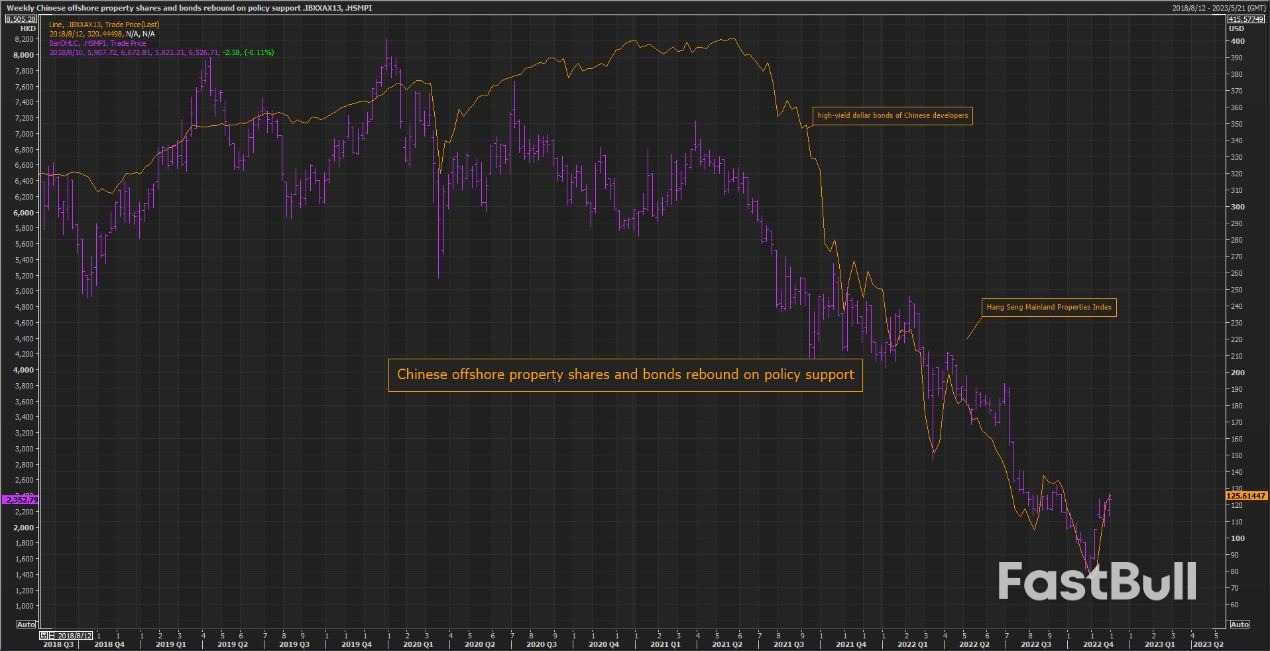
          An index tracking high-yield dollar bonds of Chinese developers has jumped more than 70% from its Nov. 3 low, but is still down about 70% from its peak in May, 2021.
          Chinese Developers' Offshore Creditors Eye Bargains; Cautious on Demand_1Despite the recent price jump, Dong said, "It's not too late to buy," as the market mood has not fully recovered.
          A growing list of Chinese developers have entered into or are preparing to kick-off debt restructuring talks with offshore bondholders after defaulting on payments.
          For example, China Evergrande Group, which is at the centre of the property crisis, aims to win creditors' approval for a plan to restructure offshore debt worth $22.7 billion by as soon as the end of February.
          The bleak sector outlook, with falling home sales and fewer sources of raising fresh funding for developments, has raised the prospect of a massive haircut for offshore bondholders.
          "We have turned slightly less negative, but believe only a handful of private Chinese real estate firms will survive without having to restructure," said Max Wolman, senior portfolio manager at abrdn, which owns such bonds, but is underweight on the sector.

          Demand Outlook

          Fund managers have been cutting their holdings in Chinese property bonds by half or even more this year as the sector lurched from crisis to crisis and blew a deep hole in asset managers' performance.
          Of 241 dollar-denominated bonds issued by Chinese property firms, 211 are trading in distressed territory below 50 cents on the dollar, Refinitiv data shows.
          The recent rally in developers' shares and bonds on the back of funding support measures, however, has given investors some respite. In November, Hong Kong's Hang Seng Mainland Properties Index posted a record monthly gain of 70%.
          Yet concerns swirl about how long the rally will last, as well as if investors will return to the debt market in the absence of a rebound in-home demand, with October seeing a 15th straight monthly fall in property sales, measured by floor area.
          "There is a remarkable turn of property policies, but companies cannot get back onto their feet without bringing back sales," said Li Gen, chief executive of Beijing-based BG Capital Management Ltd, which specialises in credit investment.
          Some investors are betting on China's easing of lengthy COVID-19 curbs, following nationwide protests against the world's toughest measures, to bring a revival in home sales.
          "A recovery in property sales would be firmer in a re-opening scenario," said Justin Ong of Columbia Threadneedle, which holds China property bonds, as it would offer a clearer timeline for re-opening.

          Source: Reuters

          Risk Warnings and Disclaimers
          You understand and acknowledge that there is a high degree of risk involved in trading. Following any strategies or investment methods may lead to potential losses. The content on the site is provided by our contributors and analysts for information purposes only. You are solely responsible for determining whether any trading assets, securities, strategy, or any other product is suitable for investing based on your own investment objectives and financial situation.
          Comments
          Add to Favorites
          Share

          Korea's Exports Log Steeper Fall in November on Weak Chip Demand

          Ukadike Micheal
          Korea's exports fell for the second consecutive month in November and the decline accelerated from the previous month due mainly to the dwindling global demand for semiconductors amid the economic slowdown, the trade ministry said Thursday.
          The country also suffered a trade deficit for the eighth straight month on high global energy prices, ringing an alarm over its growth momentum.
          Outbound shipments fell 14 percent on-year to come to $51.91 billion last month, following a 5.7 percent on-year fall the previous month, according to the data compiled by the Ministry of Trade, Industry and Energy.
          It is the first time since early 2020 that exports fell for the second month in a row. Korea last reported declining exports for more than two months from March through August in 2020.
          The country's imports grew 2.7 percent on-year to $58.93 billion in November on high global energy prices, resulting in a trade deficit of $7.01 billion.
          Imports have exceeded exports in Korea since April, and it is the first time since 1997 that the country has suffered a trade deficit for the eighth straight month.
          Korea depends on imports for most of its energy needs, and the country's energy imports surged 27.1 percent on-year to $15.51 billion in November, the ministry said.
          The trade deficit for the first 11 months of this year came to $42.6 billion, which already surpassed the record high yearly shortfall of $20.62 billion logged in 1996, according to the data.
          The fall in exports was blamed on the global economic slowdown amid high inflation and aggressive monetary tightening by major economies, as well as the impacts of the ongoing truckers' strike that began Nov. 24 over minimum freight rates, according to the ministry.
          The nationwide walkout has caused supply disruptions in major industries, and it is feared to affect the broader economy by hurting overseas shipments, according to officials. The government ordered truckers to return to work, while their negotiations have made no progress.
          A high base effect was also behind the exports fall last month, as exports spiked 31.9 percent on-year in November last year, the ministry said.
          For the first 11 months of this year, however, exports grew 7.8 percent to come to an all-time high of $629.1 billion, the ministry said.
          By item, overseas sales of semiconductors, a key export item, tumbled 29.8 percent on-year to $8.45 billion in November on falling demand and the drop in chip prices, the data showed.
          The chip exports have logged an on-year decline since August.
          Sales of petrochemicals also fell 26.5 percent to $3.55 billion, and exports of steel products decreased 10.6 percent to $2.99 billion last month. Exports of ships sank 68.2 percent to $1.12 billion.
          But car exports jumped 31 percent to $5.4 billion, an all-time monthly high, and sales of petroleum products advanced 26 percent to $4.88 billion.
          Shipments of auto parts inched up 0.9 percent to $1.86 billion, and those of secondary batteries rose 0.5 percent to $740 million last month, the data showed.
          By nation, exports to China, Korea's No. 1 trading partner, fell 25.5 percent to $11.38 billion last month on the economic slowdown in China.
          Exports to China have been on the decline since June, and Korea recorded a $760 million shortfall in trade with China last month alone, according to the ministry.
          Shipments to the Association of Southeast Asian Nations (ASEAN) also slid 13.9 percent to $9.08 billion. ASEAN comprises Brunei, Cambodia, Indonesia, Laos, Malaysia, Myanmar, the Philippines, Thailand, Singapore and Vietnam.
          But Korea's exports to the United States rose 8 percent to $8.79 billion, and those to the European Union added 0.1 percent to $5.3 billion, the data showed.
          Exports bound for the Commonwealth of Independent States grew 4.6 percent to $1.29 billion in November due to low base effects, the ministry said.
          "Given our high dependence on the global economic situation, it is necessary to revive export momentum to seek a breakthrough," Industry Minister Lee Chang-yang said.
          "The government will thoroughly carry out tailor-made export promotion strategies, such as diversifying items and better supporting local exporters."

          Source: Yonhap

          Risk Warnings and Disclaimers
          You understand and acknowledge that there is a high degree of risk involved in trading. Following any strategies or investment methods may lead to potential losses. The content on the site is provided by our contributors and analysts for information purposes only. You are solely responsible for determining whether any trading assets, securities, strategy, or any other product is suitable for investing based on your own investment objectives and financial situation.
          Comments
          Add to Favorites
          Share

          Slower U.S. Rate Hikes Could Buy Time for Businesses to Plan Better

          Owen Li

          Economic

          Slower interest rate hikes expected from the United States' central bank could buy time for the economy to feel the effects of earlier monetary policy moves, and allow businesses to plan better.
          This would bring some relief to markets concerned about the U.S. Federal Reserve overtightening too quickly, analysts told CNA on Thursday (Dec 1).
          "What it means is, we're going to get to the same destination. It's just going to take a little bit more time to get there," said Mr Tony Nash, founder and chief executive of data analytics firm Complete Intelligence.
          On Wednesday, U.S. Fed chairman Jerome Powell said the central bank could scale back its pace of interest rate hikes as soon as this month.
          Fighting Surging Inflation
          But the fight against red-hot inflation is far from over and Fed monetary policy will have to stay tight for some time to restore price stability, Mr Powell cautioned.
          Inflation and some pressures on markets are coming down a little, Mr Nash told CNA's Asia First. "So, the Fed is seeing some things that they want, and they're worried about overtightening too quickly."
          The Fed has been trying to tame inflation not seen since the 1980s, while avoiding tipping the U.S. into a recession.
          It has raised the benchmark lending rate by 0.75 percentage points four consecutive times and across six rate hikes this year, to rein in rising prices.
          Policymakers have been looking to curb spending by making it more costly to borrow. The latest increase - on Nov 2 - took the benchmark lending rate to 3.75 to 4 per cent, the highest since January 2008.
          The terminal federal funds rate is likely to stay at between 5 to 5.5 per cent, which observers believe will be reached by the end of the first quarter next year.
          The Fed will likely take a more balanced approach from the first quarter, said Mr Nash. "If we do say 50 basis points in December, maybe another 50 in January, and (then) we'll see some 25 basis point hikes after that."
          But consecutively raising interest rates by 75 basis points "just puts some real planning challenges in front of operators, people who run companies", said Mr Nash.
          "So if they slow down that pace, and people know we're still going to get to that 5 or 5.5 per cent, it allows people to plan a little bit more thoughtfully and a little bit more intelligently."
          Mr Arindam Sandilya, head of Emerging Asia Local Markets and FX Derivatives Strategy at JPMorgan, said the easing of the pace of rate hikes would allow the U.S. to buy some time to see if inflation comes down the way it has projected.
          "There is a possibility that it doesn't, in which case the Fed has to go again in the second half and that's not a trivial probability either," he told CNA938's Asia First.
          "So for that reason, I'm just trying to stay open-minded into 2023."
          U.S. Recession In 2023?
          On Wednesday, Mr Powell also said inflation remains "far too high", and that there was still a need to take interest rates to a "sufficiently restrictive" level.
          He said the Fed would stay the course until the job is done, noting that history warns against loosening policy too early.
          Some economists believe the U.S. will likely enter a recession in the fourth quarter of 2023.
          "I think what we'll need to debate over the next few months is the depth and timing of the recession," said Mr Arindam.
          "The time gap between when rate hikes stop and the recession starts, I think, is largely conditional on the quantum and pace of the rate hikes."
          Heading into 2023, the baseline outlook still calls for U.S. dollar strength, but of lower magnitude and a different composition than this year, JPMorgan said earlier.
          The USD can fare well, even if there is a mild U.S. recession, said Mr Arindam, highlighting that such events tend to spur flight to the buying of the dollar.
          From an investment flow standpoint, "the rest of the world really doesn't look very appetising", he added.
          "So we just don't see the natural, organic capital pull out of the U.S. into other parts of the world that will give U.S. dollar weakness."

          Source: CNA

          To stay updated on all economic events of today, please check out our Economic calendar
          Risk Warnings and Disclaimers
          You understand and acknowledge that there is a high degree of risk involved in trading. Following any strategies or investment methods may lead to potential losses. The content on the site is provided by our contributors and analysts for information purposes only. You are solely responsible for determining whether any trading assets, securities, strategy, or any other product is suitable for investing based on your own investment objectives and financial situation.
          Comments
          Add to Favorites
          Share
          FastBull
          Copyright © 2025 FastBull Ltd

          728 RM B 7/F GEE LOK IND BLDG NO 34 HUNG TO RD KWUN TONG KLN HONG KONG

          TelegramInstagramTwitterfacebooklinkedin
          App Store Google Play Google Play
          Products
          Charts

          Chats

          Q&A with Experts
          Screeners
          Economic Calendar
          Data
          Tools
          Membership
          Features
          Function
          Markets
          Copy Trading
          Latest Signals
          Contests
          News
          Analysis
          24/7
          Columns
          Education
          Company
          Careers
          About Us
          Contact Us
          Advertising
          Help Center
          Feedback
          User Agreement
          Privacy Policy
          Business

          White Label

          Data API

          Web Plug-ins

          Poster Maker

          Affiliate Program

          Risk Disclosure

          The risk of loss in trading financial instruments such as stocks, FX, commodities, futures, bonds, ETFs and crypto can be substantial. You may sustain a total loss of the funds that you deposit with your broker. Therefore, you should carefully consider whether such trading is suitable for you in light of your circumstances and financial resources.

          No decision to invest should be made without thoroughly conducting due diligence by yourself or consulting with your financial advisors. Our web content might not suit you since we don't know your financial conditions and investment needs. Our financial information might have latency or contain inaccuracy, so you should be fully responsible for any of your trading and investment decisions. The company will not be responsible for your capital loss.

          Without getting permission from the website, you are not allowed to copy the website's graphics, texts, or trademarks. Intellectual property rights in the content or data incorporated into this website belong to its providers and exchange merchants.

          Not Logged In

          Log in to access more features

          FastBull Membership

          Not yet

          Purchase

          Become a signal provider
          Help Center
          Customer Service
          Dark Mode
          Price Up/Down Colors

          Log In

          Sign Up

          Position
          Layout
          Fullscreen
          Default to Chart
          The chart page opens by default when you visit fastbull.com